Short answer: Rebranding a B2B company that sells in Toronto and Vancouver means running one rebrand with two local rollouts. Keep the name, identity and message identical in both cities, then plan each city's sales team, Google Business Profile, directory listings, bilingual assets and launch day separately, under one shared checklist and one launch sequence.
If you are rebranding a B2B company with clients in Toronto and Vancouver, the design work is the same as any rebrand. The rollout is not: you have two sales teams, two sets of local listings and often two language mixes. This guide covers only the rollout. For the full process from discovery to identity, start with our company rebranding process, step by step.
Key takeaways
Treat a two-city rebrand as one brand decision and two local rollouts, with a named owner in each city.
Brief each city's sales team before any client hears, so key accounts get the news from their own contact.
Update every Google Business Profile and directory listing to the same new name and category in both cities.
Map every old URL to its new page with permanent redirects before launch, and plan bilingual assets per city rather than translating once.
What changes when a B2B rebrand has to launch in Toronto and Vancouver?
The brand should not change between cities. What changes is the surface area: every rollout task now has two owners and two chances to drift.
If one city launches cleanly and the other lags, clients who deal with both see two versions of the company.
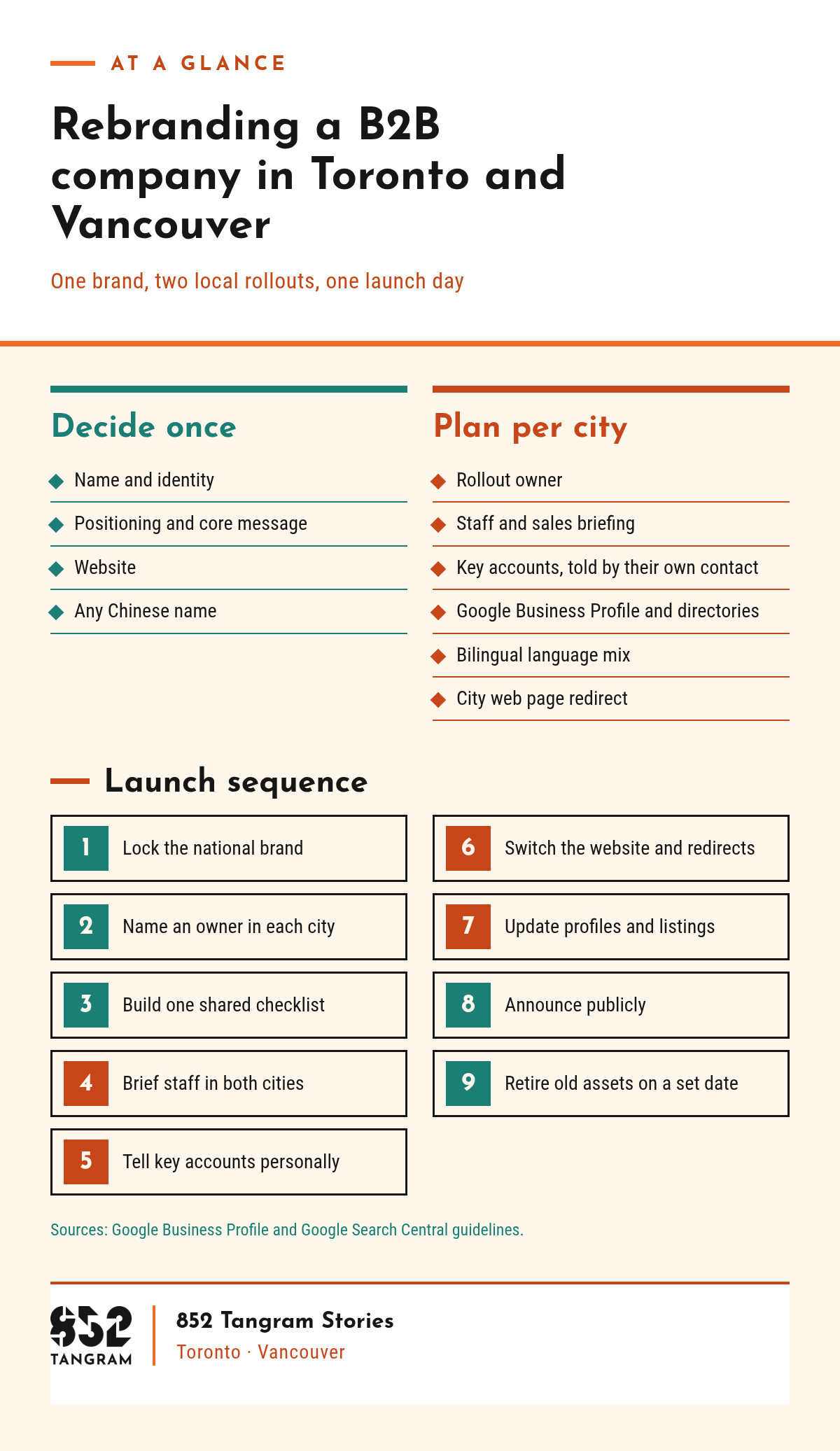
Decide the national pieces once: name, identity, positioning, website and the core message about why the brand changed. Then give each city a short local plan with a named owner, covering people, listings, language and print. Our brand rollout plan explains the four rollout phases. In a two-city launch, run each phase in both cities and move on only when both are ready.
Who needs to hear about the rebrand first in each city?
Your own people hear first, in both cities, before any client does. Then each city's key accounts hear from the person who already owns that relationship.
B2B relationships are local. A Vancouver client should not learn about the rebrand from a Toronto-run email blast. Build a stakeholder list per city:
Leadership and the sales or account lead for that city
Front-line staff who answer the phone and the inbox
Key accounts and active proposals, with the owner of each relationship named
Partners, distributors and referral sources in that metro
Brief both cities in the same week with the same internal FAQ. Give each sales lead a short script: what changed, what stayed the same, and what it means for contracts, invoices and contacts. If you rely on referrals, our guide to rebranding a professional-services firm covers how to protect them.
Planning a rebrand that has to land in both cities at once?
Book a free strategy call, or send us a short note and we'll reply by email (the short form is at the end of this post).
How do you update Google Business Profiles and directory listings in two cities?
Update every location's profile to the exact new name on launch day, and keep the name and main category identical across Toronto and Vancouver. Google's own guidelines expect this consistency.
Google's guidelines for Business Profiles say your profile name should reflect your real-world name as used on your storefront, website and stationery. All locations in the same country must use the same name and share the same category if they provide the same service, and you should not create more than one profile per location.
For a two-city rebrand, that means:
Change the real world first. Website, signage and stationery should show the new name no later than the profiles do.
Change both cities together. One profile on the new name and one on the old looks like two companies.
Edit, do not duplicate. Update the existing profile for each location rather than creating a second one.
If you serve clients at their sites, Google treats you as a service-area business: one profile for the central office with a service area, or one per location when each has separate staff and a separate service area.
Then work through every directory in each city: industry directories, chambers of commerce, supplier portals and partner pages. Keep one sheet, one row per listing, with city, owner and date changed.
What bilingual assets need to change in a two-city rebrand?
Every second-language asset needs its own review, and the language mix may differ between the two cities. Plan bilingual assets per city instead of translating one master set.
852 Tangram is a bilingual creative agency serving Toronto/GTA and Vancouver, so this is the part we plan most carefully. Typical bilingual assets:
The brand name or descriptor in Chinese, if you use one, with the script (Traditional or Simplified) decided for each audience
Bilingual sales decks, capability statements and one-page leave-behinds
Second-language web pages, titles and descriptions
Business cards, email signatures, proposal templates and signage
Decide any Chinese name at the identity stage, not at print time, and lock it in the brand guidelines. Then brief each city's language needs separately, and have a fluent reviewer in that market check every translated asset before it prints.
How should you plan the website, URLs and redirects?
Map every old URL to its new home and set up permanent redirects before launch day, so you keep the search visibility you have earned.
Google's guidance on site moves with URL changes recommends a mapping of old URLs to new ones, server-side permanent redirects (301 or 308), no chains of redirects, and updating internal links and your sitemap. It advises against redirecting many old URLs to the home page and says to keep redirects generally at least one year.
For a two-city company, add three checks:
City pages. Separate Toronto and Vancouver pages each need their own redirect to their own new page.
Listing links. Every profile and directory listing should point to the right new city page.
Local backlinks. Ask each city's owner to request link updates from local partners and associations.
See how long a rebrand takes for where website work sits in the timeline.
What is the right launch sequence for a Toronto and Vancouver rebrand?
Launch both cities on the same day, once both teams are briefed and both sets of assets are ready. A staggered launch leaves a window where clients see two brands.
Lock the national brand. Name, identity, guidelines, message and any Chinese name.
Name an owner in each city. One person in Toronto and one in Vancouver owns the local checklist.
Build one shared checklist. Every asset, listing, URL and printed item, with a city column.
Brief staff in both cities. Same week, same internal FAQ, same sales script.
Tell key accounts personally. Each relationship owner contacts their own clients first.
Switch the website and redirects. Test every redirect, including city pages.
Update profiles and listings. Every profile and directory, in both cities, on launch day.
Announce publicly. One public announcement for both cities, timed so both teams can answer replies.
Retire old assets on a set date. After a short transition window, retire print, signage and templates in both cities.
Toronto vs Vancouver rollout checklist
| Item | Toronto / GTA | Vancouver |
|---|---|---|
| Rollout owner | Named Toronto lead | Named Vancouver lead |
| Staff briefing | Same week, shared FAQ | Same week, shared FAQ |
| Key accounts | Told by their Toronto contact | Told by their Vancouver contact |
| Google Business Profile | Edit existing profile, same name and category | Edit existing profile, same name and category |
| Directories and associations | Local list, one row each | Local list, one row each |
| Bilingual assets | Language mix set for Toronto clients | Language mix set for Vancouver clients |
| City web page | Own redirect to new Toronto page | Own redirect to new Vancouver page |
| Print and signage | Retired on the shared date | Retired on the shared date |
How we start a rebrand
A two-city rollout is easier to keep aligned when the rebrand starts from one shared discovery brief. The Book Treasures rebrand page on our site shows the brand review survey we used to open that project. It asks about brand identity and vision, target audience, branding and design preferences, brand style and tone, website features, content strategy, marketing and customer engagement, and who will manage the website after launch.
852 Tangram has also delivered a Vancouver rebrand and website project.
See more of our work in the portfolio.
Frequently asked questions
How do you rebrand a B2B company that sells in Toronto and Vancouver? Rebrand a B2B company that sells in Toronto and Vancouver by locking one national brand first, then running two local rollouts from a single checklist. Name a rollout owner in each city, brief both sales teams in the same week, update listings in both cities together, and launch the website and announcement on the same day.
Should a two-city rebrand launch in Toronto and Vancouver on the same day? A two-city rebrand should launch in Toronto and Vancouver on the same day. A staggered launch creates a window where clients, partners and search results show two versions of the company. Brief both teams first, then switch the website, profiles and announcement together.
Do I need separate Google Business Profiles for Toronto and Vancouver after a rebrand? After a rebrand, you keep one Google Business Profile per real location and edit each existing profile rather than creating new ones. Google's guidelines say all locations in the same country should use the same name and share the same category when they offer the same service, so Toronto and Vancouver profiles should match.
Who should tell clients about a B2B rebrand in each city? In a B2B rebrand, the person who already owns each client relationship should tell that client, in each city. Toronto accounts hear from their Toronto contact and Vancouver accounts from their Vancouver contact, before any public announcement. Give every owner the same short script.
Do bilingual assets need to be the same in Toronto and Vancouver? Bilingual assets in a Toronto and Vancouver rebrand should share one approved name, identity and message, but the language mix can differ by city. Decide any Chinese name at the identity stage, set the script per audience, and have a fluent reviewer in each market check translated decks, web pages and print before launch.
How do you protect search rankings when a two-city company rebrands? A two-city company protects search rankings during a rebrand by mapping every old URL to its new page and using permanent server-side redirects. Google recommends avoiding redirect chains, updating internal links and the sitemap, and keeping redirects generally for at least one year. Each Toronto and Vancouver city page needs its own redirect.
Talk to 852 Tangram
Rebranding a company that sells in Toronto and Vancouver? We can plan the national brand and both local rollouts as one project.
Book a free strategy call, or send us a short note and we'll reply by email.
Sources
Google Business Profile Help, "Guidelines for representing your business on Google": https://support.google.com/business/answer/3038177?hl=en (accessed Oct 2026)
Google Search Central, "Site moves with URL changes": https://developers.google.com/search/docs/crawling-indexing/site-move-with-url-changes (accessed Oct 2026)
About 852 Tangram: 852 Tangram is a bilingual creative agency serving Toronto/GTA and Vancouver, working in English and Chinese on branding, rebranding, websites and marketing.