Short answer: To choose a packaging design agency for a food brand in Canada, check six things: food packs on Canadian shelves, a written process for English and French copy, work in your retail channel, one approved master built into every size and language, print-ready file checks and a clear split of who signs off the label. Then ask every agency the same questions.
A portfolio shows how a pack looks. It does not show whether the French fits the back panel, the barcode scans or the files pass your printer's checks. This checklist is for food brands, importers and distributors, whether you need a new pack or a Canadian version of head-office artwork. For other creative work, see how to choose a creative agency in Toronto.
Key takeaways
Judge an agency on process as well as portfolio: approved copy, one SKU first, files checked before release.
Canada adds a bilingual layer. The Canadian Food Inspection Agency (CFIA) says mandatory information on consumer prepackaged food must be shown in English and French.
Decide who signs off the label before you hire. A design agency places and checks copy; compliance sign-off stays with your team or your adviser.
852 Tangram is a bilingual creative agency serving Toronto/GTA and Vancouver. We adapt head-office packs into English and French for Canada and design the in-store pieces that launch them.
What should a food brand look for in a packaging design agency?
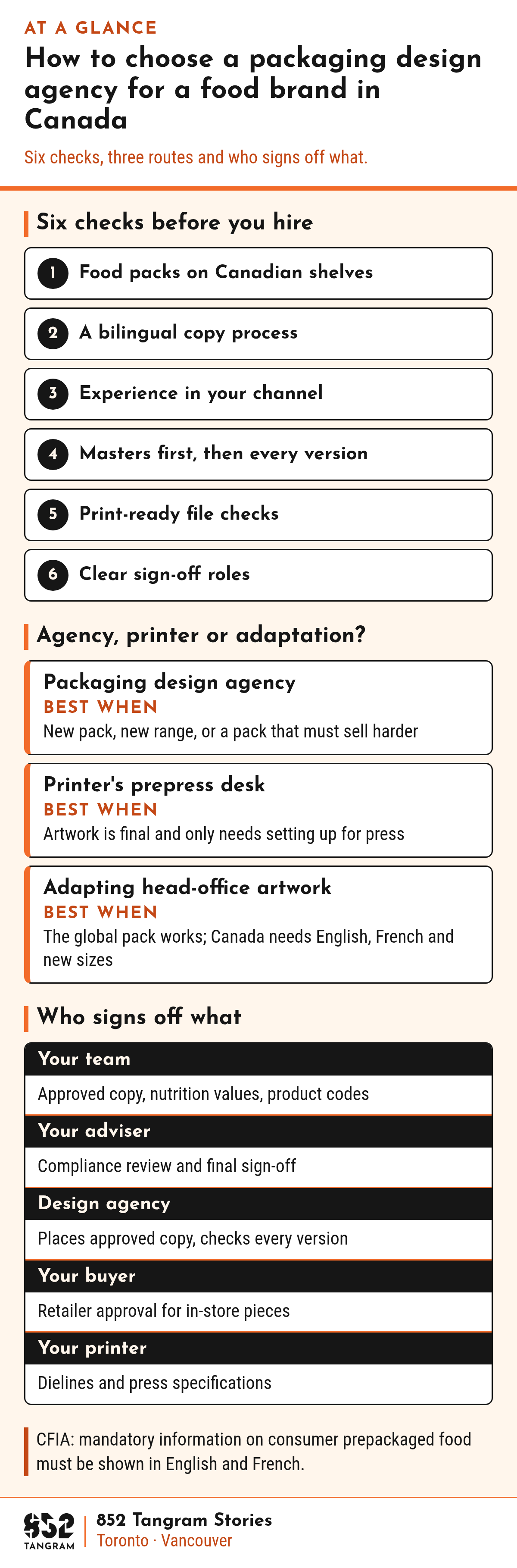
Six checks separate a packaging partner from a designer with a good front panel.
Food packs on Canadian shelves. Ask to see packs in stores now, with back and side panels.
A bilingual copy process. Ask who supplies the French, who places it and how each version is checked.
Experience in your channel. Each retailer has its own fixtures and sizes. Ask which channels the agency has designed for.
Masters first. Ask for one approved master first, then every version built from it.
Print-ready file checks. Ask how size, bleed, colour settings, fonts and image resolution are checked before files leave the studio.
Clear roles. Get it in writing: who approves copy, signs off compliance and talks to the printer.
Do you need a design agency, a printer or an adaptation of head-office artwork?
Three routes get a pack to print.
| Route | Best when | What to ask |
|---|---|---|
| Packaging design agency | New pack, new range, or a pack that must sell harder | How it handles French copy and print files |
| Printer's prepress desk | Artwork is final and only needs setting up for press | Who checks copy and makes layout changes |
| Adapting head-office artwork | The global pack works; Canada needs English, French and new sizes | How the brand look survives longer French copy |
If your imported product already sells at home, adaptation is often the right first step. Our bilingual packaging adaptation covers English and French label text from approved copy, a bilingual Nutrition Facts table, the importer line and Canadian dielines. Redesign on purpose, not because the French did not fit.
What does Canada add to a packaging brief?
A good agency raises three layers before it shows any design.
English and French. The CFIA's bilingual food labelling page states: "Mandatory information on consumer prepackaged food must be shown in both official languages, that is, French and English." Exemptions are narrow: the CFIA notes that "the majority of imported foods" do not meet its definition of a specialty food. The same page says Quebec "has additional requirements concerning the use of the French language on all products marketed in Quebec." Chinese or Korean can stay on the pack, but the CFIA does not permit other languages inside the Nutrition Facts table. For language planning, see English, French and Chinese on one pack.
Retailer specs. Sizes, dielines, fixtures and file rules come from your retailer or printer and can change mid-job; ask how the agency handles that.
Print-ready files. Ask what "print-ready" means against your printer's specifications, and who checks the product code and barcode before release.
Bringing a food product onto Canadian shelves?
Prefer to write? The short form is at the end of this post.
Who signs off the label?
Settle this before you hire.
Your team or head office: approved copy in each language, nutrition values and product codes.
Your regulatory adviser, importer or a food labelling consultant: compliance review and final sign-off.
The design agency: places the approved copy exactly, checks every version against it, and flags anything that looks missing, such as a French common name or an importer line.
Your buyer or category manager: retailer approval for in-store pieces.
Your printer or converter: dielines and press specifications.
Designers place and check copy, but cannot sign off a label for you, and neither can we. For the label checklist, see CFIA packaging compliance for Chinese-Canadian food brands.
What questions should you ask before hiring a packaging design agency?
Ask every shortlisted agency the same questions.
Which of your food packs are on Canadian shelves now, and can we see the back and side panels?
Who places the French copy, and how do you check each version against our approved text?
Will you build one SKU first, so our reviewer can check the approach?
Which retailer specs and fixtures have you designed to?
What do you check before files go to our printer, and which files do we receive?
What do you need from us, and by when, to meet our launch date?
How many review rounds are included, and how are changes after approval handled?
Can the same team design the launch shelf talkers and sell sheets?
For the steps from research to print-ready files, see inside a bilingual food packaging design process.
Red flags: only front panels in the portfolio, vague answers on who checks the French, no list of final files, and any promise that the label is compliant.
Example (fictional, for illustration only): a GTA importer brings in six sauces from a head-office range. Its one-page brief lists six SKUs in two jar sizes, the English and French copy its adviser approved, the Chinese text to keep, the printer's dielines and target retailers. Every agency quotes the same job.
For how that scope shapes a quote, see what drives bilingual packaging design cost in Canada.
How 852 Tangram helps
Our team has 10 years of CPG experience in Asian and North American markets.
Masters first, at volume. For a global Asian food brand, we create in-store and packaging work, with more than 40 jobs across 20+ types of deliverables. Our approach for that brand: masters first, then every size, store format and language, in English, French, Chinese and Korean.
Checks before print. For that brand, we spotted a product code that was one digit short, confirmed it with a check, and rebuilt the barcode before anything went to print.
One SKU first, then the range. For adaptation, we build one SKU first, so your team and your regulatory reviewer can check the approach, then roll out the remaining SKUs and pack sizes.
Shelf pieces from the same masters. Our in-store POSM design covers shelf talkers, wobblers and endcap headers, built to your fixture and printer specifications.
Frequently asked questions
What should a food brand look for in a packaging design agency?
Look for food packs on Canadian shelves, a written process for English and French copy, experience with your retail channel and checked print-ready files. A good agency asks about your shopper, retailer and head-office artwork before showing any design. Book a free strategy call at https://calendly.com/852tangram/free-strategy-call.
Do products sold in Canada need bilingual packaging?
For consumer prepackaged food, generally yes. The CFIA says mandatory information must be shown in both English and French, with narrow exemptions for specialty, local and test market foods. Quebec adds its own French-language requirements. Your adviser confirms compliance. Book a free strategy call at https://calendly.com/852tangram/free-strategy-call.
What is the difference between a packaging design agency and a printer?
A design agency plans and designs the pack: hierarchy, artwork, bilingual layout and every size version. A printer produces the physical labels, boxes and pouches. Ask each who checks dielines, colour proofs and copy before anything goes to press. Book a free strategy call at https://calendly.com/852tangram/free-strategy-call.
Who signs off a food label before print?
Your team supplies approved copy, and your regulatory adviser, importer or a food labelling consultant gives final compliance sign-off. The design agency places that copy exactly, checks every version against it and flags anything that looks missing. Agree these roles in writing. Book a free strategy call at https://calendly.com/852tangram/free-strategy-call.
Can one agency adapt head-office packaging and design in-store materials too?
Yes, and it helps: the pack, shelf talkers, sell sheets and promo pieces then share one master and one look. Ask whether the agency builds to retailer specs and handles small, fast repeat jobs. Book a free strategy call at https://calendly.com/852tangram/free-strategy-call.
How do you brief a packaging design agency?
Send your head-office artwork and source files, the approved copy in each language, your SKU list and sizes, the target retailers and their specs, your printer's dielines and the launch date. Send every agency the same brief. Book a free strategy call at https://calendly.com/852tangram/free-strategy-call.
Talk to 852 Tangram
Planning a Canadian launch or a new pack size? We can review your head-office artwork and retailer list and recommend the route that fits.
Prefer to write? Send a short note below.
Sources
Canadian Food Inspection Agency: Bilingual food labelling (page date modified 2025-09-03; accessed Nov 9, 2026)