Short answer: Bilingual packaging design cost in Canada depends on scope, not a fixed price list. The number of SKUs, the languages on pack (English and French, plus Chinese if your channel needs it), label compliance review, dieline work, photography, print proofs, timeline and revision rounds set the quote. Define those first and quotes become comparable.
Food and CPG brands in Toronto/GTA and Vancouver often get two very different packaging quotes because the studios are not pricing the same job. This guide does not list prices. It shows what goes into a bilingual packaging quote, so you can brief once and compare properly.
Key takeaways
Bilingual packaging is quoted on scope. SKUs, languages, compliance review, structure, imagery, proofing, timeline and revisions are the drivers.
Canadian law requires mandatory label information in English and French, so every mandatory element appears twice and needs space on pack.
Adding Chinese is voluntary under federal rules, but it adds copy, typesetting and proofing work, so it belongs in the first brief, not a later reprint.
The fastest route to an accurate quote is a short brief: SKU list, dielines, label content, channels, deadline and approvers.
What decides the cost of bilingual packaging design in Canada?
The cost of bilingual packaging design is decided by how much work the scope contains, and most of that work is invisible on a finished label.
A quote usually covers some or all of these stages: briefing, concept design, artwork per SKU, bilingual copy layout, compliance checks, print-ready files and proof approval. Each stage grows or shrinks with your product line: one sauce in one format is a different job from a line of flavours in jars, pouches and a shelf-ready case.
Location matters less than scope. Brands in Toronto/GTA and Vancouver selling nationally face the same federal labelling rules, so the core work is the same.
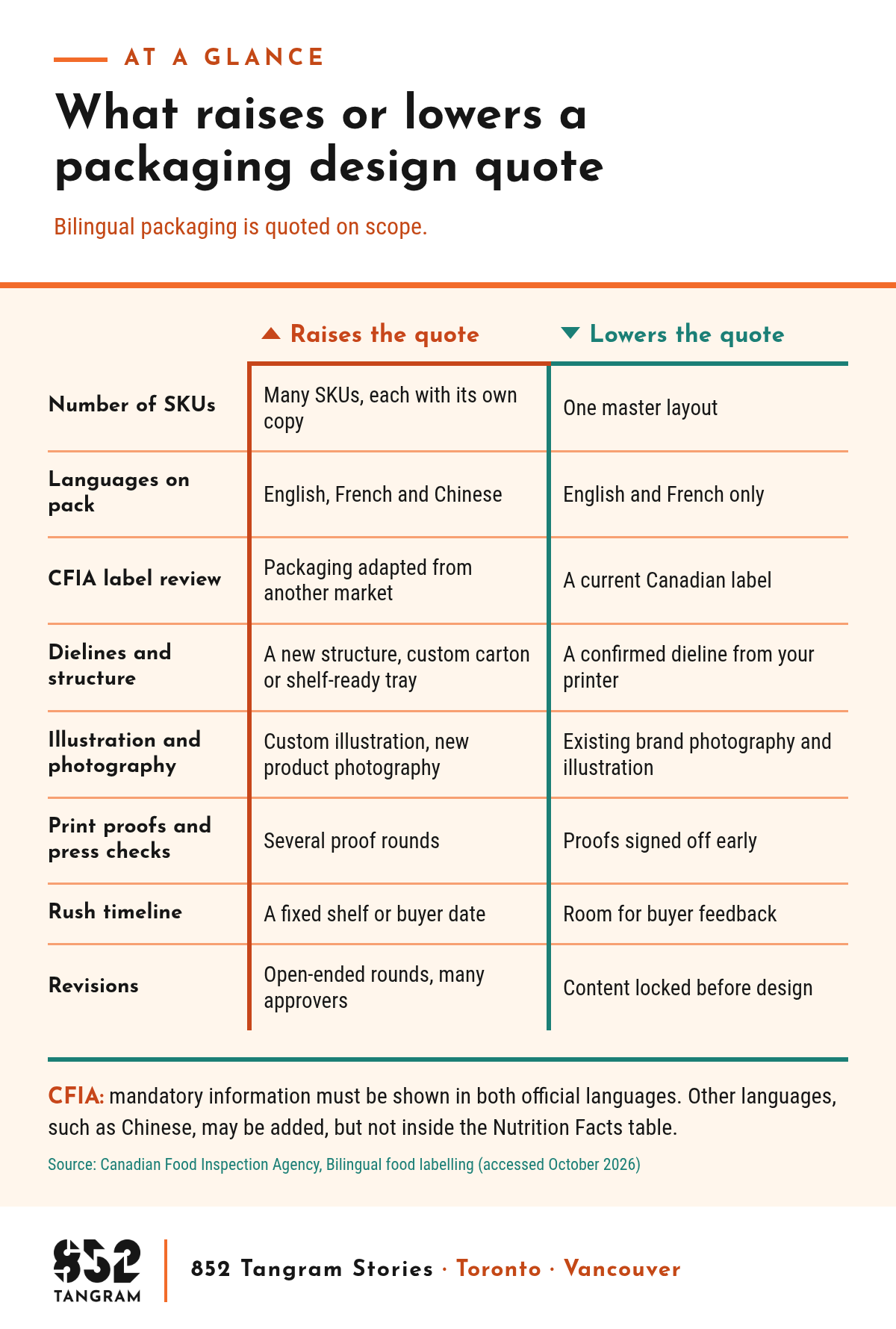
What raises or lowers a packaging design quote?
Eight drivers move most bilingual packaging quotes up or down.
What raises or lowers the quote
| Driver | Raises the quote | Lowers the quote |
|---|---|---|
| Number of SKUs | Many SKUs, each with its own copy, nutrition data or size | One master layout where only flavour, colour and copy change |
| Languages on pack | English, French and Chinese, with Chinese typeset to the same standard as the other two | English and French only, with approved translations supplied before design |
| CFIA label review | Packaging adapted from another market, or new claims (organic, nutrient content, health) that carry their own bilingual rules | A current Canadian label with stable claims and a confirmed ingredient list |
| Dielines and structure | A new structure, custom carton or shelf-ready tray designed from scratch | A confirmed dieline from your printer for a stock format |
| Illustration and photography | Custom illustration, new product photography or renders for buyer meetings | Existing brand photography and illustration that can be reused |
| Print proofs and press checks | Several proof rounds, more than one printer or substrate, an on-press colour check | One printer, one substrate, proofs signed off early |
| Rush timeline | A fixed shelf or buyer date that compresses design and proofing | A schedule with room for buyer feedback and proof rounds |
| Revisions | Open-ended rounds, many approvers, and changes after artwork is final | Agreed rounds, one decision-maker, and content locked before design |
The biggest savings usually come from the last row: late changes ripple through every SKU and every language.
What do CFIA bilingual labelling requirements mean for your quote?
CFIA bilingual labelling requirements mean that mandatory information on consumer prepackaged food must appear in both English and French, so every mandatory element takes space twice. That is the base layer of any Canadian food packaging scope. According to the Canadian Food Inspection Agency's bilingual food labelling page:
Mandatory information, including the common name, must be shown in both official languages. The dealer's name and principal place of business may be in either language.
English and French text must each meet minimum type height requirements. They do not have to be the same height, although CFIA encourages the same height for legibility.
Separate English and French principal display panels are allowed when another surface is at least as large and prominent.
Voluntary information is generally not subject to federal bilingual rules, but organic claims, nutrient content claims and health claims must be bilingual when used.
Other languages, such as Chinese, may be added as long as mandatory information is in English and French and nothing is misleading. Other languages are not permitted inside the Nutrition Facts table.
Exemptions (specialty, local and test market foods) are narrow, and most imported foods do not qualify. Quebec has additional French-language requirements.
For a quote, this means planning panel space for two sets of mandatory content before brand design starts. This is a planning summary, not legal advice: check your product category in CFIA's Industry Labelling Tool before final artwork. For the full breakdown, see our guide to bilingual packaging in Canada: English and Chinese vs English and French and the CFIA packaging compliance guide for Chinese-Canadian food brands.
Does adding Chinese to English and French packaging cost more?
Adding Chinese usually raises the quote, because a third language adds copywriting, typesetting, proofing and layout work around the mandatory English and French content. Federal rules do not require Chinese, so the decision is commercial.
Three decisions shape the scope:
Which script. Confirm with your retail channel whether it expects Traditional or Simplified Chinese before typesetting starts.
Where it sits. Chinese cannot go inside the Nutrition Facts table, so it lives on the front panel, a side panel or the back, and the hierarchy has to be planned for each SKU.
When it is designed. Designing all languages together from the first layout is less work than adding Chinese to finished artwork.
If Asian grocery chains are part of your plan, read packaging design for Asian grocery distribution in the GTA before you brief.
Book a free strategy call, or send us a short note and we'll reply by email (the short form is at the end of this post).
How do you get an accurate bilingual packaging design quote?
You get an accurate bilingual packaging design quote by giving every studio the same written scope, so each one prices the same job:
List every SKU and format. Product, size and pack type.
Name your channels and markets. National grocery, Asian grocery, online or Quebec.
Decide the languages and who translates. English and French at minimum, Chinese if your channel needs it.
Get dielines from your printer or co-packer. A confirmed dieline removes a large unknown.
Gather the label content. Ingredients, allergens, nutrition data, net quantity and claims.
Share the deadline and the approvers. A shelf date and one decision-maker let the studio plan rounds.
Ask for a line-by-line quote. Design, artwork per SKU, compliance checks, imagery, proofing and revision rounds listed separately.
What should you prepare before asking for a packaging quote?
Prepare the files a studio would otherwise have to chase, because every unknown gets priced as risk:
Current packaging files, brand guidelines, logos and fonts
Dielines and printer specifications (substrate, print method, finishes)
Translation status for French and, if needed, Chinese
Existing product photography or illustration you own
Target retailers, launch date and who signs off
If something is not ready, say so in the brief so it can be scoped.
Proof: 10 Toronto CPG launches
852 Tangram has taken products through 10 Toronto CPG launches into Asian grocery retail. The lessons are written up in shelf-ready packaging lessons from 10 Toronto CPG launches: confirm the dieline before design begins, plan product photography during design rather than after approval, and design both languages at the same time. Each one prevents a round of rework.
Frequently asked questions
How much does bilingual packaging design cost in Canada? Bilingual packaging design cost in Canada depends on scope rather than a set price. The main drivers are the number of SKUs, the languages on pack, CFIA label review, dielines and structure, illustration or photography, print proofs, rush timelines and revision rounds. A written brief covering these drivers is the quickest way to get comparable quotes.
Is bilingual English and French labelling required on food packaging in Canada? Yes. The Canadian Food Inspection Agency states that mandatory information on consumer prepackaged food, including the common name, must be shown in English and French. Narrow exemptions exist for specialty foods, local foods and test market foods, and the dealer name and principal place of business may appear in either official language.
Can I add Chinese to Canadian food packaging? Yes. CFIA allows languages other than English and French on food labels, provided all mandatory information appears in English and French and the other language is not misleading. Chinese cannot be used inside the Nutrition Facts table, so it is usually placed on the front, side or back panels with a planned hierarchy.
Does adding Chinese make bilingual packaging design more expensive? Adding Chinese to English and French packaging usually increases the design scope, because a third language needs copywriting, typesetting, proofing and layout space around the mandatory content. The increase is smallest when Chinese is planned in the first brief and designed together with English and French, rather than added to finished artwork.
What makes a packaging design quote go up? A packaging design quote usually goes up with more SKUs, a third language, packaging adapted from another market, new dielines or custom structures, new photography, several proof rounds, rush deadlines and open-ended revisions. Locking ingredients, claims and translations before design starts is the most reliable way to keep a quote stable.
Does packaging design cost differ between Toronto and Vancouver? Packaging design scope is largely the same in Toronto and Vancouver, because brands selling nationally follow the same federal labelling rules in both cities. Quotes differ mainly with the product line, the retail channels, the languages on pack and the timeline. Brands selling in Quebec should also plan for that province's additional French-language requirements.
What should I send a studio to get an accurate packaging quote? To get an accurate packaging quote, send a list of SKUs and formats, dielines from your printer, label content such as ingredients, allergens and nutrition data, the languages you need, your retail channels, your launch date and who approves the work. The more complete the brief, the less risk the studio has to price in.
Sources
Canadian Food Inspection Agency, Bilingual food labelling, Industry Labelling Tool, page modified 2025-09-03, accessed October 2026.
Canadian Food Inspection Agency, Food labelling for industry (Industry Labelling Tool), accessed October 2026.
Talk to 852 Tangram
Book a free strategy call, or send us a short note and we’ll reply by email.
Based in Toronto. Working with clients across Canada, including Vancouver.
About 852 Tangram: 852 Tangram is a bilingual creative agency serving Toronto/GTA and Vancouver. We build packaging, brand identity, video and social media systems for brands reaching English and Chinese-Canadian audiences. See our portfolio or read about us.