Short answer: Choose an English-Chinese marketing agency in Vancouver by checking four things on the first call: who writes and directs the Chinese creative, which platforms they plan for your buyers and why, whether they treat Mandarin vs Cantonese and Traditional vs Simplified as strategy decisions, and how they will report enquiries by audience in the first 90 days.
If you sell to Chinese-speaking customers in Metro Vancouver, a translated English caption is not a bilingual plan. This buyer's guide is for B2B teams comparing English-Chinese marketing services in Vancouver. To compare the two cities, start with bilingual marketing in Vancouver vs Toronto. For the Toronto hiring checklist, see what to look for in a bilingual marketing agency in Toronto.
Key takeaways
- Native bilingual strategy starts from audience, channel and language mix. Translation is a production step, not the plan.
- Ask who on the team writes and reviews Chinese creative, and in which script and spoken variety.
- If your buyers use WeChat or Xiaohongshu, plan those channels alongside Google and Instagram. Match the mix to your buyers, not to a generic social calendar.
- A clear first-90-days plan and account ownership protect you after the kickoff call.
- 852 Tangram is a bilingual creative agency serving Toronto/GTA and Vancouver. We plan English and Chinese work as one system so your brand wins clients in both languages.
Why isn't translating English posts enough for Vancouver's Chinese market?
Translating English posts is not enough when your Chinese-speaking buyers discover, trust and enquire on different channels, or with different language expectations, than your English audience.
A caption that reads correctly in Chinese can still miss the point if the offer, proof and call to action were written for an English LinkedIn feed. Native bilingual work starts from what that audience needs to believe before they enquire, then expresses the same brand position in the right language and channel. Translation comes after the message is clear.
Which platforms matter for Chinese-speaking customers in Metro Vancouver?
The platforms that matter depend on who you sell to: if your buyers use WeChat or Xiaohongshu, plan those alongside Google and Instagram.
- WeChat, if your buyers use it, for community, updates and warmer relationships with people already in your network.
- Xiaohongshu when discovery and lifestyle proof matter for your category.
- Google for high-intent search in English and Chinese, including Business Profiles and landing pages.
- Instagram when your English and Chinese audiences already meet you there, or when visual proof does the selling.
Ask any agency to map your buyers to channels before they propose a content calendar. Our note on WeChat vs Instagram for Chinese Canadians shows why channel choice is a strategy call, not a posting habit.
Mandarin vs Cantonese, Traditional vs Simplified: what should an agency cover?
An English-Chinese agency should tell you which spoken variety and which written script your Vancouver audience actually uses, and who on their team can write and review that mix.
Do not assume your Chinese-speaking buyers are one audience. They may prefer Cantonese in conversation and Traditional Chinese in print, Mandarin and Simplified, or a mix that changes by context. A serious agency will ask about your customers' origin markets, age mix and buying journey before locking a script. "We can translate" is not a language plan.
How do you tell native bilingual strategy from a translation add-on?
Native bilingual strategy shows up as shared positioning, separate expression and a named review path. A translation add-on shows up as English first, Chinese later, with no one accountable for tone.
Ask for:
- One position, two expressions. The brand promise stays the same. The proof, examples and calls to action are written for each audience.
- A Chinese creative owner. A person who writes or directs Chinese work, not only a vendor who converts files.
- A bilingual review step before anything client-facing goes live.
- Reporting by audience. Enquiries, calls and form fills tagged so you can see English and Chinese performance separately.
If the proposal only lists "Chinese translation" under deliverables, you are buying production, not strategy. For first-call questions in a related hire, see what to ask a bilingual Toronto branding agency.
Comparing English-Chinese marketing partners for Vancouver?
Book a free strategy call, or send us a short note and we'll reply by email (the short form is at the end of this post).
Who on the team should write and direct the Chinese creative?
Someone with a named role should write or direct the Chinese creative, and a fluent reviewer should sign off before publish.
On the first call, ask:
- Who writes the Chinese copy and who approves it?
- Do they work in Traditional, Simplified, or both, and for which audiences?
- Can they show Chinese work they led, not only English work that was translated later?
- How do English and Chinese teams share one brief so the brand does not drift?
Agencies that cannot name those people are not ready to run your Chinese channels.
Can a non-Chinese-owned B2B brand still win with English-Chinese marketing in Vancouver?
Yes. A non-Chinese-owned B2B brand can win in Vancouver when the work is respectful, accurate and useful, and when Chinese-speaking customers can enquire in the language they prefer.
You do not need to pretend to be a Chinese-owned company. You do need clear offers, proof your buyers care about, and creative that does not read like a machine-translated brochure. Hire for cultural fluency and process, not for decoration.
What should the first 90 days look like?
The first 90 days should move from discovery to a written plan to controlled channel work, with reporting agreed before launch.
- Discovery. Audience, language mix, channels, current assets, sales handoff.
- Strategy. Positioning, offers, message pillars, channel plan, success metrics.
- Setup. Accounts, templates, landing pages, tracking, review workflow.
- Pilot. One or two channels live, with a short feedback loop.
- Review. Enquiries by audience, what to scale, what to stop.
Ask for this as a written plan, not a slide of vague phases.
How should results be reported across English and Chinese audiences?
Report enquiries, calls and qualified opportunities by audience and channel, not only total followers or impressions.
Vanity metrics hide whether Chinese creative is creating pipeline. A useful monthly report shows what ran in each language, what it cost, what enquiries it produced, and what the sales team did next. If an agency cannot separate English and Chinese results, you cannot manage the investment.
Who owns ad accounts, social logins and creative files?
You should own the ad accounts, social logins, pixel or tag access, and master creative files. The agency should work inside your accounts as a user, not as the landlord.
Put ownership in the contract before kickoff. When the engagement ends, you keep the history, audiences and files. This is standard hygiene for any bilingual program that spends money to win clients.
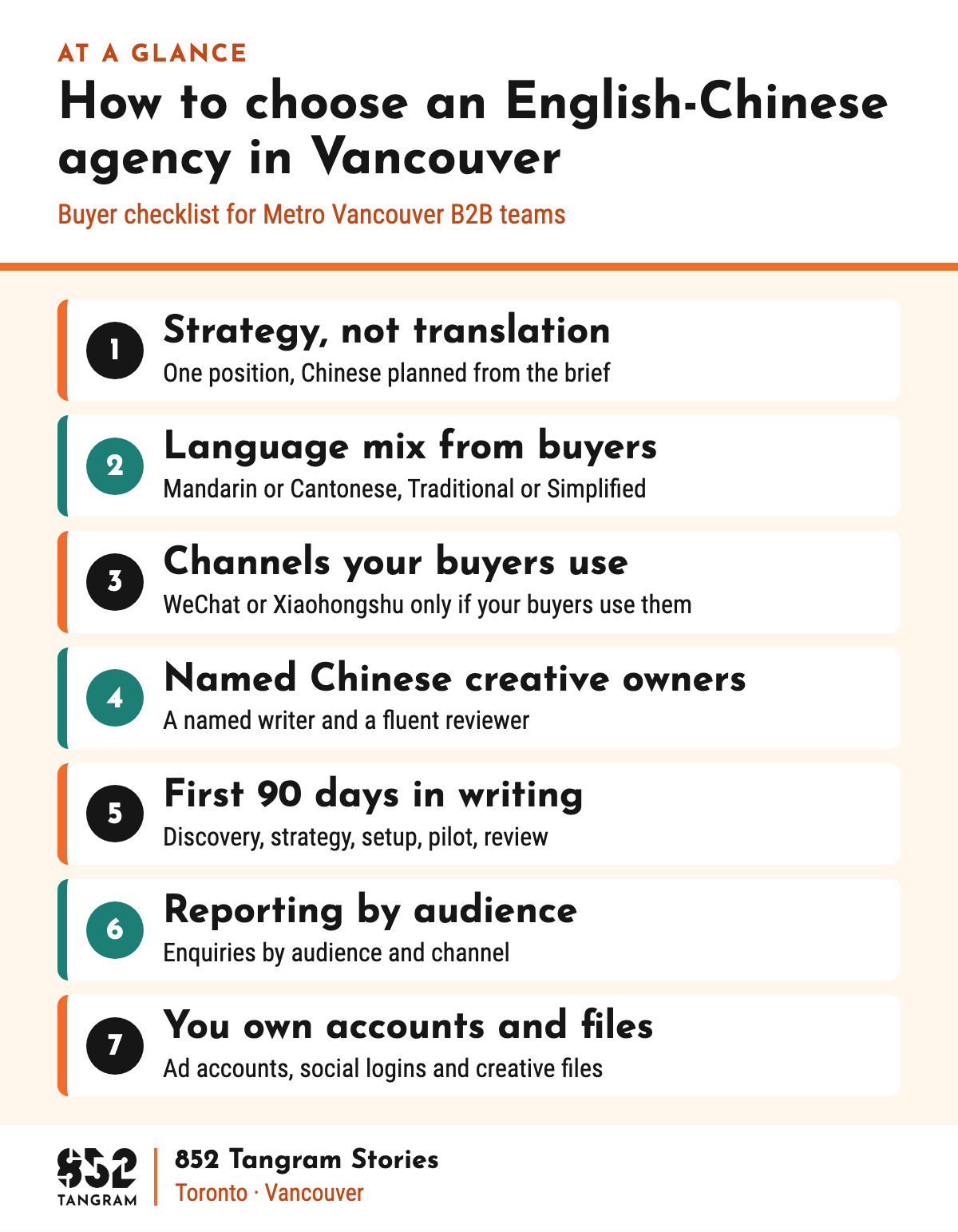
Buyer checklist: English-Chinese agency in Vancouver
| Check | What good looks like | Red flag |
|---|---|---|
| Strategy vs translation | One position, Chinese expression planned from the brief | "We will translate the English posts" |
| Language mix | Clear call on Mandarin/Cantonese and Traditional/Simplified | "Chinese" with no script or variety named |
| Platforms | Channel map tied to your buyers | Same calendar copied from English social |
| Chinese creative owners | Named writer/director and reviewer | No names, only a vendor |
| First 90 days | Discovery, plan, pilot, review | Big launch with no pilot |
| Reporting | Enquiries by audience and channel | Follower counts only |
| Ownership | You own accounts and files | Agency-owned ad accounts |
How 852 Tangram helps
852 Tangram is a bilingual creative agency serving Toronto/GTA and Vancouver. We help B2B teams plan English-Chinese marketing as one system: audience and language mix first, then creative, channels and reporting that show which work wins clients.
We have delivered a Vancouver rebrand and website project. See more of our work in the portfolio.
Frequently asked questions
How do I choose an English-Chinese marketing agency in Vancouver? Choose an English-Chinese marketing agency in Vancouver by testing for native bilingual strategy, a clear language mix, a channel plan for your buyers, named Chinese creative owners, a first-90-days plan, audience-level reporting and your ownership of accounts and files from day one. Book a free strategy call at https://calendly.com/852tangram/free-strategy-call
Is translating English content enough for Vancouver's Chinese market? Translating English content is not enough for Vancouver's Chinese market when discovery channels, proof and enquiry paths differ by audience. Plan the Chinese expression from the brief, then translate or adapt with a fluent reviewer before anything goes live. Book a free strategy call at https://calendly.com/852tangram/free-strategy-call
Which platforms should an English-Chinese agency use in Metro Vancouver? Platforms for an English-Chinese program in Metro Vancouver depend on your buyers: if they use WeChat or Xiaohongshu, plan those alongside Google and Instagram. Ask the agency to map your audience to channels before they propose a calendar, and to explain why each channel earns a place. Book a free strategy call at https://calendly.com/852tangram/free-strategy-call
Should my Vancouver campaign use Traditional or Simplified Chinese? Use the script your customers actually read. Your Metro Vancouver customers may prefer Traditional Chinese, Simplified, or a mix that changes by context. A good agency will recommend a mix from your customer data, not from habit, and name who writes and reviews each script. Book a free strategy call at https://calendly.com/852tangram/free-strategy-call
What should I ask on the first call with a bilingual agency? Ask who writes and reviews Chinese creative, which platforms they recommend for your buyers, how Mandarin vs Cantonese and script choices will be decided, what the first 90 days include, how results are reported by audience, and who owns the accounts and files. Book a free strategy call at https://calendly.com/852tangram/free-strategy-call
How is Vancouver different from Toronto for bilingual B2B marketing? Do not assume a Toronto bilingual plan carries over to Vancouver: plan from your Vancouver buyers' own language mix and channel habits. Compare the two cities in our guide to bilingual marketing in Vancouver vs Toronto, then hire against the city you are trying to win. Book a free strategy call at https://calendly.com/852tangram/free-strategy-call
Talk to 852 Tangram
Hiring for English-Chinese marketing in Vancouver? We can help you scope the audience, language mix and first 90 days before you commit to a retainer.
Book a free strategy call, or send us a short note and we'll reply by email.
About 852 Tangram: 852 Tangram is a bilingual creative agency serving Toronto/GTA and Vancouver, working in English and Chinese on branding, websites and marketing.