Short answer: Bilingual marketing in Vancouver vs Toronto needs one national brand and two local versions. Keep your positioning, visual identity, offer and proof the same. Change the language mix, the Chinese script and dialect you lead with, the place names, the channels you test first and the local references, because each metro's audience is built differently.
If you sell into both metros, there are two common mistakes: a Toronto campaign pasted into Vancouver unchanged, or two separate brands that no longer look like the same company. This guide shows B2B marketing leads and founders what to localize for each city and what to keep national, using Statistics Canada 2021 Census language data for both metropolitan areas.
Key takeaways
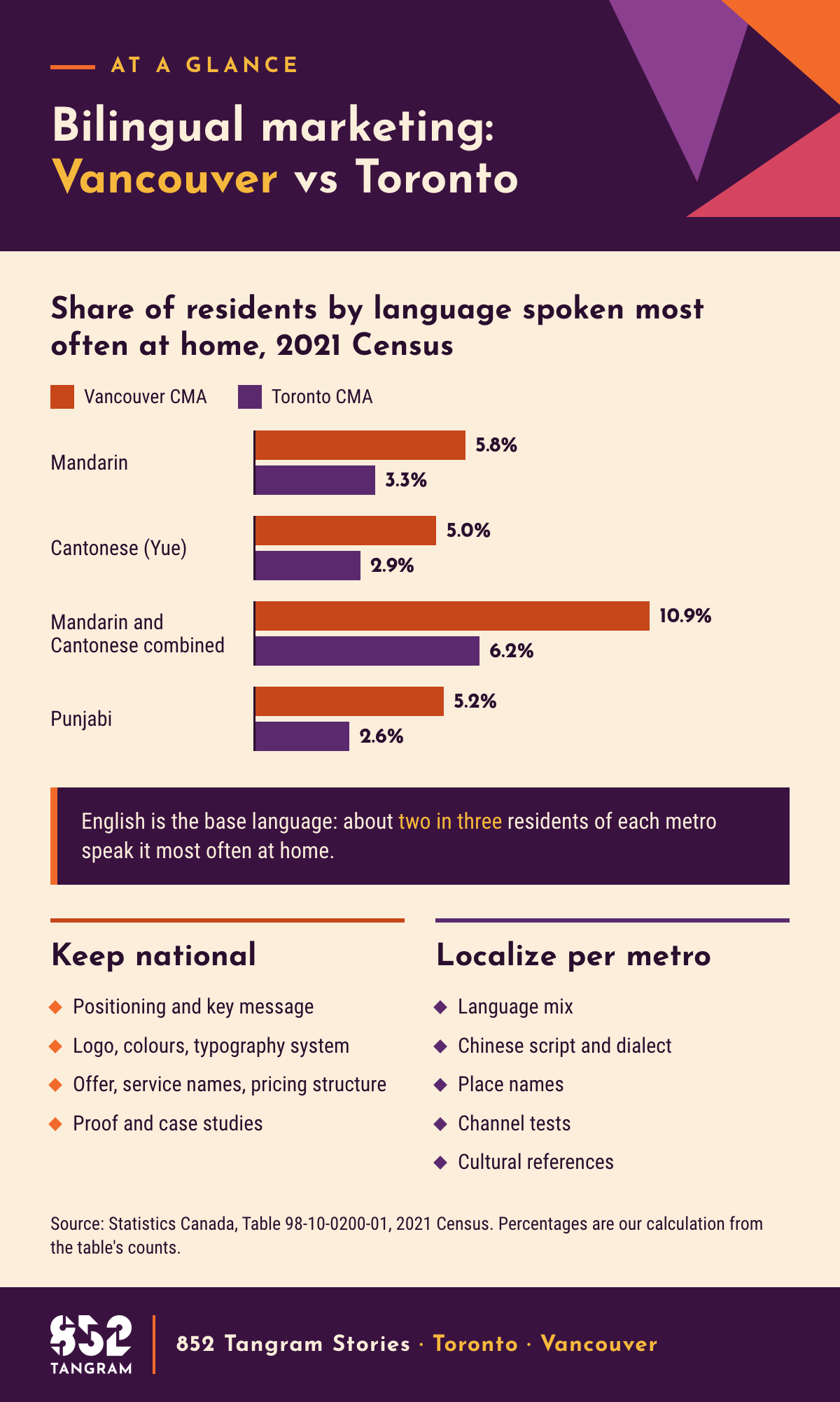
Chinese languages are a much bigger share of the Vancouver market: about 10.9% of Vancouver CMA residents speak Mandarin or Cantonese most often at home, compared with about 6.2% in the Toronto CMA (2021 Census).
Mandarin is the leading non-official home language in both metros, but Cantonese is close behind in both, so neither city is a "Mandarin only" market.
In Vancouver, Punjabi ranks second among home languages other than English and French, ahead of Cantonese. Plan your second language by audience, not by habit.
Keep the brand, offer and proof national. Localize language, script, place names, channels and cultural references.
How is the bilingual market different in Vancouver vs Toronto?
The biggest difference is weight. Chinese languages make up a larger share of Vancouver's market than Toronto's, while Toronto has the larger absolute audience and a wider spread of other languages competing for attention.
Here is what the 2021 Census shows for language spoken most often at home (Statistics Canada, Table 98-10-0200-01):
| Language spoken most often at home (2021) | Toronto CMA | Vancouver CMA |
|---|---|---|
| Total (population in private households) | 6,161,570 | 2,619,420 |
| English | 4,035,545 (65.5%) | 1,726,210 (65.9%) |
| Mandarin | 204,415 (3.3%) | 152,805 (5.8%) |
| Cantonese (Yue) | 177,950 (2.9%) | 131,660 (5.0%) |
| Mandarin and Cantonese combined | 382,365 (6.2%) | 284,465 (10.9%) |
| Punjabi | 161,965 (2.6%) | 136,300 (5.2%) |
| Rank of Cantonese among non-official home languages | 2nd | 3rd |
Percentages are our calculation from the table's counts (single responses), using the total for each CMA.
Two things stand out. English is the main home language for roughly two in three people in both metros, so English stays your base language everywhere. And about one in nine Vancouver residents speaks Mandarin or Cantonese most often at home, against about one in sixteen in Toronto. In Vancouver, a Chinese-language version is closer to a core requirement. In Toronto, it is a targeting decision you make per segment.
Toronto still has more Mandarin and Cantonese speakers in absolute terms, so segmentation inside the GTA is the main job there, as our guide to marketing to Chinese Canadians in the GTA explains.
What should B2B brands localize for each metro?
Localize anything the buyer reads as "made for here": language mix, Chinese script and dialect, place names, channel tests and cultural references. Keep everything else identical.
1. Language mix. Decide the second language per metro and per audience. In both metros Mandarin and Cantonese are the two largest Chinese home languages. In Vancouver, Punjabi is also larger than Cantonese, so depending on who you sell to, your Vancouver plan may need a different second language from your Toronto plan.
2. Script and dialect. Spoken and written choices are separate decisions. Cantonese voice-over, Mandarin voice-over, Traditional characters and Simplified characters each signal a different audience. Our post on Cantonese vs Mandarin marketing in Canada explains how to choose. Do not assume the answer is the same in both cities: brief it per campaign.
3. Place names. "Toronto" and "Vancouver" are not where most buyers say they work. Name the municipality or district your buyer uses, for example Markham or Mississauga in the GTA and Burnaby or Surrey in Metro Vancouver. Use the official English spelling and the established Chinese name your audience already recognizes, and keep both consistent across your website, listings and print.
4. Channel tests. Run the same channel test in both metros before you split budget, with one creative per segment, and compare results by metro. Our WeChat vs Instagram comparison covers which platform fits which segment.
5. Cultural references. Landmarks, sports teams, weather and neighbourhood food references are where national campaigns sound borrowed. Replace them per metro and have a local reviewer check them.
What should stay national across Toronto and Vancouver?
Keep the parts that make you recognisable and trustworthy: positioning, brand identity, offer structure, proof and the review process. If these change between cities, buyers who see both versions will not know which company they are talking to.
| Element | Keep national | Localize per metro |
|---|---|---|
| Positioning and key message | Yes | Wording only, not meaning |
| Logo, colours, typography system | Yes | Chinese typeface choice per script |
| Offer, service names, pricing structure | Yes | Local examples |
| Proof and case studies | Yes | Which case you lead with |
| Language mix and script | No | Yes, per audience |
| Place names and maps | No | Yes |
| Channels and launch order | Shared test plan | Budget split |
| Cultural references and imagery | Shared photo style | Local scenes and events |
Use the table as a sign-off checklist: changing anything in the "keep national" column is a brand decision, not a translation decision.
Want help mapping your Toronto and Vancouver versions?
Book a free strategy call, or send us a short note and we'll reply by email (the short form is at the end of this post).
Should you use Cantonese or Mandarin in Vancouver vs Toronto?
Plan for both in both metros, then choose the lead language per campaign and segment. The 2021 Census shows Mandarin slightly ahead of Cantonese as a home language in both the Toronto CMA and the Vancouver CMA, so the gap is narrow in each city.
What changes between cities is the stakes. With about 5.0% of Vancouver CMA residents speaking Cantonese most often at home, against about 2.9% in the Toronto CMA, leaving Cantonese out costs you a bigger slice of the Vancouver market. A practical approach:
Lead with the language that matches your best existing customers in each metro, not the national average.
Prepare both written versions of your core assets (key web pages, a one-page overview) so either metro team can use them.
Review results by metro after one campaign cycle and adjust the lead language.
If your audience includes newer arrivals from Hong Kong, our Hong Kong diaspora marketing guide covers what that segment expects.
How do you run one bilingual campaign across both cities?
Run one campaign with one master brief, then add a one-page metro brief for Toronto and one for Vancouver. Translate from the master, localize from the metro brief, and review both versions with the same checklist before launch.
Write the master brief in English. Message, offer, proof and call to action.
Write two metro briefs. Segments, lead language and script, place names, channels and local references.
Translate once, adapt twice. Translate the master copy, then adapt headlines, examples and imagery per metro instead of retranslating from scratch.
Review with a native reader per metro. Check tone, script, place names and any cultural reference. Our bilingual marketing materials guide covers layout and quality control.
Launch the same test in both cities. Same offer, same timing, one variable changed at a time.
Compare results by metro. A blended report hides which city is driving the result.
What does this look like in practice?
The work is usually less about new creative and more about a clear split between national and local decisions.
852 Tangram has delivered a Vancouver rebrand and website project.
852 Tangram is a bilingual creative agency serving Toronto/GTA and Vancouver. We plan the metro split before translation begins, so both versions look and sound like the same company. See more of our work in the portfolio.
Frequently asked questions
What is the main difference between bilingual marketing in Vancouver and Toronto? The main difference between bilingual marketing in Vancouver and Toronto is market weight. In the 2021 Census, about 10.9% of Vancouver CMA residents spoke Mandarin or Cantonese most often at home, compared with about 6.2% in the Toronto CMA. Chinese-language versions therefore reach a larger share of the Vancouver market.
Is Toronto or Vancouver a bigger market for Chinese-language marketing? Toronto is the bigger market for Chinese-language marketing in absolute numbers, while Vancouver has the higher share. The 2021 Census counted about 382,000 Mandarin and Cantonese home speakers in the Toronto CMA and about 284,000 in the Vancouver CMA, where they make up a much larger part of the population.
Should a B2B brand use Cantonese or Mandarin in Vancouver? A B2B brand marketing in Vancouver should usually prepare both Cantonese and Mandarin, then lead with the language its best customers use. The 2021 Census shows about 5.8% of Vancouver CMA residents speaking Mandarin and about 5.0% speaking Cantonese most often at home, so both groups are large enough to plan for.
What should stay the same when marketing in both Toronto and Vancouver? When marketing in both Toronto and Vancouver, keep positioning, brand identity, the offer, service names and proof the same in both metros. Localize the language mix, Chinese script and dialect, place names, channel tests and cultural references. That way buyers who see both versions still recognize one company.
Is English enough for B2B marketing in Vancouver and Toronto? English is the base language for B2B marketing in Vancouver and Toronto, since about two in three residents of each metro speak it most often at home. English alone, though, misses buyers who prefer another language, and Mandarin, Cantonese and Punjabi are each spoken at home by large groups in both metros.
Do I need a separate bilingual marketing agency in Vancouver? A separate bilingual marketing agency in Vancouver is not required if one team plans both metros with a master brief and a local brief per city. What matters is that someone reviews the Vancouver version with local knowledge of language, place names and references before it launches.
Talk to 852 Tangram
Planning a campaign, website or rebrand for both Toronto and Vancouver? We can help you decide what stays national and what changes.
Book a free strategy call, or send us a short note and we’ll reply by email.
Sources
Statistics Canada. Table 98-10-0200-01, Language spoken most often at home by other language(s) spoken regularly at home: Canada, provinces and territories, census metropolitan areas and census agglomerations with parts (2021 Census, 100% data). https://www150.statcan.gc.ca/t1/tbl1/en/tv.action?pid=9810020001. Accessed Oct 2026.
About 852 Tangram: 852 Tangram is a bilingual creative agency serving Toronto/GTA and Vancouver, working in English and Chinese on branding, websites, packaging and marketing.