Short answer: Corporate video production is the planning, filming, editing and delivery of a video that an organization commissions for a business goal: a brand film, a training video, an event recap, an explainer, a recruitment video or an investor and AGM video. To choose a company in Toronto, check work in your format, the named crew, a written scope, language versions, permits and rights.
This is a guide to video production for corporate teams in Toronto and the GTA, written for marketing, HR and communications staff who are about to brief a video. It explains what each type is for, how a production runs, how to choose a company, and how to plan English, Cantonese and Mandarin versions.
Key takeaways
Start from the job the video must do. The type decides the script, the crew and the files you need at the end.
Judge a production company on finished work in your format and on the named people who will be on your shoot, not on a showreel alone.
In Toronto, commercial filming on City streets or in City parks needs a permit from the City's Film Office. Ask who applies, and when.
Plan language versions before the shoot. Cantonese and Mandarin are different spoken languages, so one Chinese version rarely serves both audiences.
852 Tangram is a bilingual creative agency in Toronto. We film events and premieres, edit highlight films and interviews, and made an animated film for an exhibition by Casa Loma and Toronto Hydro.
What is corporate video production?
Corporate video production is the process of making a video for a business purpose, from the brief to the final files. A production company or agency plans the video, films it, edits it and delivers it in the formats you need. The video speaks for your organization to customers, staff, candidates, investors or members.
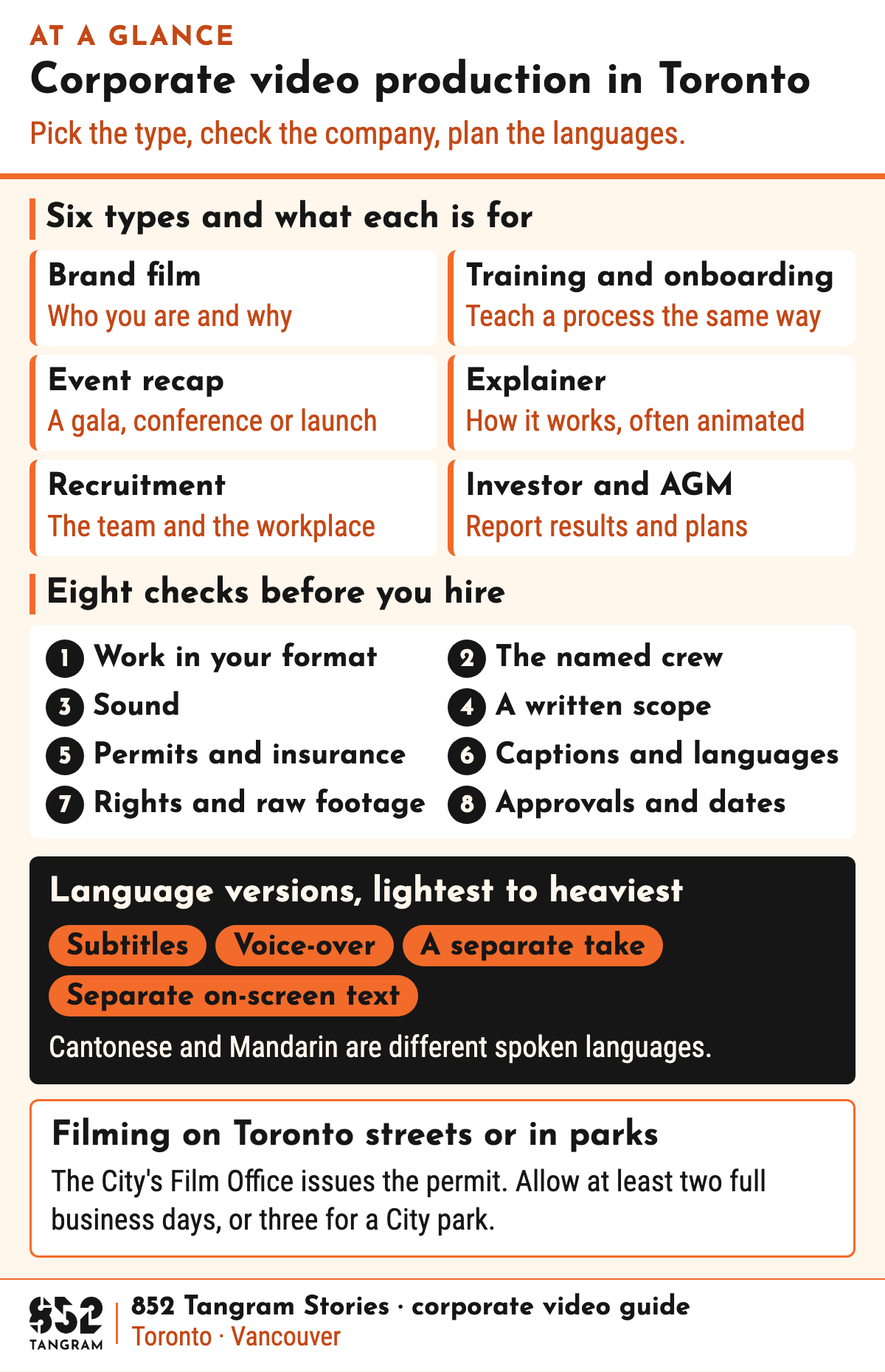
Six types cover most corporate briefs. Each needs a different plan.
| Type | Use it to | Plan for |
|---|---|---|
| Brand film | Show who you are and why you do the work | One clear story told by real people |
| Training and onboarding | Teach a process the same way every time | Accurate steps, short chapters, captions |
| Event recap | Capture a gala, conference or launch | A run sheet, key moments, a fast first cut |
| Explainer | Show how a product or service works, often with animation | A script first, simple graphics |
| Recruitment | Show candidates the team and the workplace | Staff on camera, signed releases |
| Investor and AGM | Report results and plans to shareholders or members | Approved wording and a fixed meeting date |
Some teams treat "brand video" and "corporate video" as two separate categories. Here, a brand film is one type of corporate video; for the side-by-side comparison, see brand video vs corporate video.
Galas, conferences and launches need their own plan. See event videography for corporate galas and our event photography and videography page: one team can cover event photography and event videography at the same event.
What should a corporate video include?
A corporate video should include one goal, one audience, one main message and one clear action for the viewer, plus captions and a version for each channel. The written scope should name every finished cut, the revision rounds, the music licence, the formats, the usage rights and who owns the files. Agree both before anyone films.
On screen, that usually means a strong first few seconds, real people and places from your organization, on-screen text that works with the sound off, and an ending that tells viewers what to do next.
For the scope, we keep a ten-item checklist in what a corporate video production package should include. Use it to compare proposals line by line.
How does corporate video production work, step by step?
Corporate video production runs in five steps: the brief, pre-production, the shoot, the edit with revision rounds, and delivery of every version. The shoot is usually the shortest step. Delays tend to come from the steps around it, such as scripts waiting for sign-off, so name one approver on your side at the start.
Brief. The goal, the audience, where the video will run, the lengths and languages, the dates and who approves.
Pre-production. Script or interview questions, shot list, locations and permits, talent and signed releases, and a schedule for the day. If your speakers are new to the camera, send them the questions ahead, start with a warm-up question, and let each person answer in their first language.
Shoot. Crew, cameras, lights and sound on site. One shoot day can feed several videos if the shot list is planned for them.
Edit and revisions. A first cut, one combined list of comments from your team, then colour, sound mix, graphics and captions.
Delivery. The main video plus each cut by length, format and language, with the music licence and rights in writing.
For how long each step takes, see the corporate video production timeline. If the brief needs more than one day on set, such as a training library or several locations, read how to plan a multi-day video production shoot. For Holding Space Films, we worked as crew on The Belle Method, a two-day studio shoot for an online fitness library.
Planning a corporate video in Toronto?
Prefer to write? The short form is at the end of this post.
How do you choose a corporate video production company in Toronto?
Choose on evidence: finished work in the same format as yours, the named people who will run your shoot, a written scope you can compare, a plan for sound, captions and languages, and clear answers on permits and rights. Send every company the same brief, so the answers line up side by side.
Use this checklist with every company on your shortlist.
Work in your format. Ask for two or three finished videos closest to yours, such as a training series, an event recap or an animation. Watch them in full, with sound.
The named crew. Ask who directs, who shoots, who records sound and who edits, and whether those people will be on your day.
Sound. Interviews depend on clean audio. Ask how each speaker is miked and who listens on set.
A written scope. Every cut, length, revision round and format in writing, with what is excluded.
Permits and insurance. Ask who checks whether a location needs a permit, who applies, who sends the notice letters, and whether the crew can supply the insurance certificate a venue or the City asks for.
Captions and languages. Ask which caption files you receive and who checks each language version.
Rights and raw footage. Ask who owns the final files, where you may use them, and whether raw footage is delivered.
Approvals and dates. One approver on your side, a date for each draft and a date for final delivery.
Filming on Toronto streets or in parks. The City of Toronto's Film Office issues permits for commercial location filming. Its guidelines say it needs "a minimum of two full business days, not including day of submission, to issue a filming permit," or three full business days if the request includes a City park. The film company must give written notice to affected residents and businesses at least 48 hours before it arrives. Special events and internal corporate training videos do not qualify for a City film permit, but the City notes they "may require permits or approvals from other city divisions" on City property.
For the questions to ask on the first call, see questions to ask before hiring a video production company.
Red flags: a showreel but no full-length examples, vague answers on who will be on set, no written list of deliverables, and silence on rights and permits.
Should you make English, Cantonese and Mandarin versions?
Make Cantonese and Mandarin versions when your viewers include Chinese-speaking customers, staff or members in the GTA, and plan them before the shoot. Cantonese and Mandarin are different spoken languages, and written Chinese uses Traditional or Simplified script, so one "Chinese version" rarely serves both. Decide for each audience how its version will be made.
There are four ways to make a language version, from lightest to heaviest:
Subtitles. The English video with Traditional or Simplified Chinese subtitles. Frame shots so two lines of subtitles do not cover names or graphics.
Voice-over. A new narration track in Cantonese or Mandarin. It suits explainers and animation, where no one speaks on camera.
A separate take. The speaker records each line again in the second language, or a native speaker presents that version. It suits training and messages from leadership.
Separate on-screen text. Titles, name captions and end cards built as editable layers, so each language gets its own graphics.
Plan this at the brief. Have each script approved by a native reviewer, interview people in their first language, and ask for a caption file per language. For script choice and the differences between the two audiences, see Cantonese vs Mandarin marketing.
We have planned shoots for more than one language. For EP Learning, one shoot day had to cover ads and reels in two languages: we made 4K video ads and reels for the learning centre in English and Chinese. For Kinghome Canada, we made six step-by-step tutorial videos in English and French.
How 852 Tangram helps
An animated film, storyboard to sound. The company that operates Casa Loma commissioned a short animation about Toronto's electrification for Powering Progress: Toronto's Electric Revolution, an exhibition by Casa Loma and Toronto Hydro. We made it in 2D and 3D mixed media, from the storyboard to the sound. The delivered film runs 31 seconds, in 4K. See the Casa Loma case.
Premieres, highlight films and interviews. Illume Films brings Hong Kong cinema to Canadian screens, and we have worked with them on 19 of its films. "We photograph and film each premiere, then cut a short highlight film. We also update trailers for North America and edit cast and director interviews." For film nights, our film events page sets out the turnaround: "the first draft of a highlight video under 1 minute within 48 hours. The timing is set out in your written quote before the day."
A music video, filmed and edited. For ZeekersDanz, a K-pop and commercial dance studio in Markham, we filmed the outdoor scenes of One More Time, a music video with the camp's Performance Lab team. We edited it with Jonathan Mak and made the logo opening and credits.
Stage shows and multi-day events. For Versus, we did a multi-camera capture of a stage magic show. For event clients in Cannes, three event days needed a photo and video crew: we covered them with event photography and same-day photo edits, plus highlight films.
A video for a university library. At a charity screening of three films at Innis Town Hall for the Richard Charles Lee Canada-Hong Kong Library at the University of Toronto, with Illume Films, we handled event operations and photography, and made the library's video.
Frequently asked questions
What is a corporate movie?
A corporate movie is another name for a corporate video or company film: a video an organization commissions to introduce itself, train people, record an event or report to investors and members. It is made for a business goal and a known audience, not for general release. Book a free strategy call at https://calendly.com/852tangram/free-strategy-call.
How do you make a promotional video?
Start with one goal and one audience. Write a short script or interview questions, plan the shots and locations, then film with good light and clean sound. Edit to a strong opening, add captions and an ending that asks viewers to act, and cut a version for each channel. Book a free strategy call at https://calendly.com/852tangram/free-strategy-call.
How much should a 3 or 5 minute corporate video cost?
Length is not the main driver. The cost follows the work: the number of shoot days, the size of the crew, how many locations, any animation or graphics, and how many versions you need, such as languages and vertical cuts. A 5 minute interview filmed in one room can take less work than a 1 minute film shot in three places. Compare quotes line by line, and see video production day rates in Toronto. Book a free strategy call at https://calendly.com/852tangram/free-strategy-call.
Do you need a permit to film a corporate video in Toronto?
For commercial filming on City of Toronto streets or in City parks, yes. The City's Film Office issues the permit and needs at least two full business days, or three if you film in a City park. Special events and internal corporate training videos do not qualify for a City film permit, but they may need other City approvals on City property. Book a free strategy call at https://calendly.com/852tangram/free-strategy-call.
Can one shoot give you English, Cantonese and Mandarin versions?
Yes, if the versions are planned before the shoot. Record a separate take or presenter for each language, or plan a voice-over and subtitles in Traditional or Simplified Chinese. Have a native speaker approve each script and check each caption file. Book a free strategy call at https://calendly.com/852tangram/free-strategy-call.
What should you send a video production company before it quotes?
Send the goal, the audience, where the video will run, the lengths and formats, the languages, possible locations and dates, two or three videos you like, and who approves. Send every company the same brief, so the proposals can be compared. Book a free strategy call at https://calendly.com/852tangram/free-strategy-call.
Talk to 852 Tangram
Planning a corporate video in Toronto or the GTA? We serve Toronto, the GTA and Vancouver, and can help you write the brief first, so every proposal answers the same questions.
Prefer to write? Send a short note below.
Sources
City of Toronto: Guidelines for Filming in Toronto (page date modified June 26, 2026; accessed Nov 24, 2026)
City of Toronto: Film Permitting (page date modified March 27, 2026; accessed Nov 24, 2026)