Short answer: Map admin tasks before an AI agent touches them by shadowing your team for an ordinary working day. Watch the inbox, phone, paperwork, scheduling and handoffs, log every task with its trigger, inputs, outputs and risk, then sort each one: automate it, let the AI agent draft for a person to approve, or keep it human.
For a professional services firm in Toronto/GTA or Vancouver, mapping admin tasks before an AI agent arrives means you automate the work your team really does, not the work you think it does.
Key takeaways
Shadow the team on an ordinary day first: the real admin hides in workarounds, sticky notes and double entry.
Log every task the same way: who, trigger, how often, inputs, outputs and risk.
Sort each task into one of three lanes: automate, AI agent drafts and a person approves, or keep human.
Only standard messages a person has already approved go out automatically; anything else that goes to a client, touches money, needs professional judgement or opens confidential files gets a named person's approval.
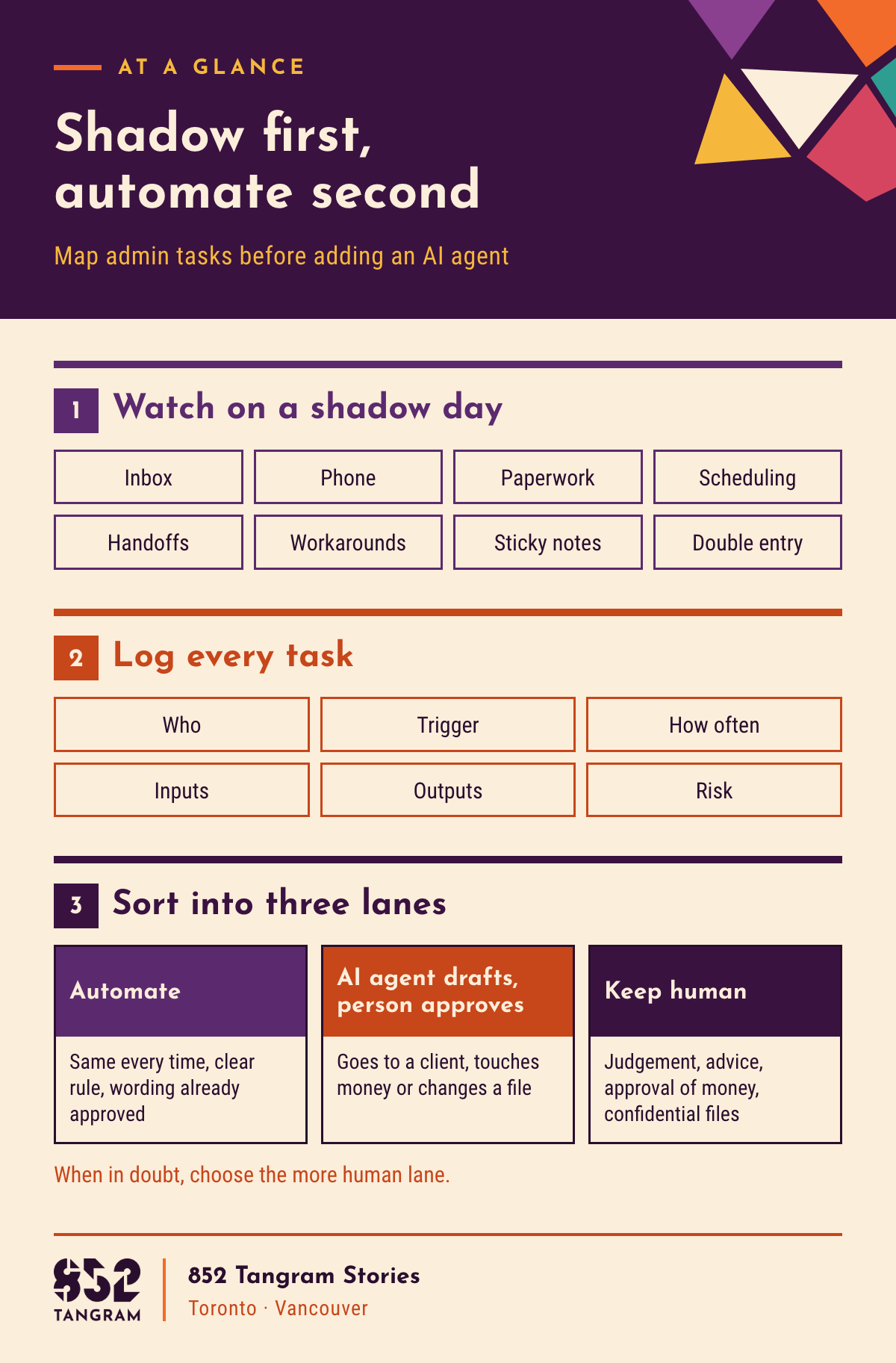
Why should you shadow your team before adding an AI agent?
Because the admin your team describes in a meeting is rarely the admin they do. Shadowing shows the real steps and shortcuts.
An AI agent, in plain words, is software that can read, sort and draft work across your inbox, forms and files, then take a set next step, such as proposing a booking or preparing a document for someone to check. It follows the process you give it, so a guessed process gets repeated faster.
It is the lesson behind why most marketing automation fails: automate a messy process and you get a faster mess.
What should you watch for during a shadow day?
Watch where work arrives, where it waits and where it gets copied by hand. That is where an AI agent can help, or do damage if you guess.
Inbox: emails that need a reply, a file or a forward.
Phone: calls that end in a booking, a change or a note on paper.
Paperwork: intake forms, signed documents and receipts that get scanned or filed.
Scheduling: bookings made, moved and confirmed, and who checks availability.
Handoffs: the moment a task passes to someone else, and how they are told.
Workarounds: the private spreadsheet, the saved reply, the "I just do it this way" step.
Sticky notes: anything written down because the system has nowhere to keep it.
Double entry: the same client detail typed into more than one place.
Workarounds and double entry matter most: they show where the current setup fails.
How do you log each admin task you find?
Log every task in one shared table, one row per task, with the same details each time.
For each task, record who does it now (by role), the trigger that starts it, how often it happens, the inputs needed, the output produced and the risk if it goes wrong. Write frequency in words (several times a day, daily, weekly, at month end, rarely) and risk as low, medium or high. One day is a snapshot; a guessed number looks more precise than it is.
Task-map table template
| Task | Who now | Trigger | How often | Inputs | Outputs | Risk | Lane |
|---|---|---|---|---|---|---|---|
| Confirm a new booking | Front desk | Booking request by email or phone | Several times a day | Request, availability | Confirmation sent, booking saved | Low | Automate |
| Chase a missing intake form | Admin | Appointment booked, form not back | Daily | Client record, blank form | Reminder sent, form filed | Medium | AI agent drafts, person approves |
| Answer a question about fees or advice | Owner or lead | Client email | Weekly | Client history, fee schedule | Reply sent | High | Keep human |
Copy the headers and replace the example rows with your own.
How do you decide what to automate, what an AI agent drafts, and what stays human?
The higher the risk and the more judgement a task needs, the closer it stays to a person. When in doubt, choose the more human lane.
Automate. The task is the same every time, follows a clear rule and uses wording a person has already approved. Examples: filing a signed form, sending a standard reminder, removing double entry.
AI agent drafts, person approves. The task needs reading, sorting or writing, but the result goes to a client, touches money or changes a file. The AI agent prepares it; a named person reviews and sends it.
Keep human. The task needs professional judgement, advice, a sensitive conversation, approval of money or confidential files. The AI agent can remind someone it is due, nothing more.
Start with one workflow, as our guide to marketing automation for small business recommends.
Want a second pair of eyes on your task map?
Book a free strategy call, or send us a short note and we'll reply by email (the short form is at the end of this post).
How do you run a shadow day, step by step?
Pick an ordinary day, brief the team, sit with each role and build the task map before you go home.
Choose an ordinary day. Avoid a launch, a holiday rush or month end.
Brief the team first. You are mapping the process, not judging anyone.
Sit with each role. Front desk, admin, the owner, and whoever handles bookings or billing.
Note tasks as they happen. Write the trigger and the steps, not just the task name.
Ask about exceptions. "What happens when a client cancels late?" uncovers workarounds.
Collect blank versions. Take blank forms and templates, never filled-in client copies.
Build the task map the same day. One row per task while your memory is fresh.
Review it with the people you shadowed. They will correct missed steps and flag risks.
Choose the first one or two tasks. Low risk, frequent and clearly in the automate or draft lane.
How do you handle staff and client privacy while shadowing?
Ask before you watch, record the process rather than the people or the clients, and keep personal details out of your notes. This is general guidance, not legal advice.
Tell staff in advance and let them pause you at sensitive moments. Step out of private client meetings, sessions and calls. Note the type of document ("signed intake form"), never its contents, names, health details or account numbers. If clients can see you, a short sign at the front desk explains why.
The same care applies to the AI agent. In Canada, PIPEDA sets the ground rules for how private-sector organizations collect, use and disclose personal information in commercial activity, and British Columbia has its own private-sector privacy law. PIPEDA's fair information principles include consent, limiting collection and safeguards. Before an AI agent touches client files, check with your regulator or professional body, especially for health, legal or financial records.
How we use this approach
852 Tangram spent time in a client's office, shadowing their team to follow their daily work, then set up an AI agent to automate their daily paperwork, class scheduling and admin. That client is a dance studio we work with.
The method is not specific to studios. An accounting or bookkeeping practice, a law office, a consultancy, a clinic or an agency has its own inbox, intake, paperwork and scheduling. The tasks change; the order does not: shadow first, map second, automate third. This is the order behind our AI operations setup for professional services. For the limits of the technology, see what AI marketing automation can't do yet.
Frequently asked questions
Why should a firm shadow its team before adding an AI agent? A firm should shadow its team before adding an AI agent because the admin people describe is rarely the admin they do. A shadow day shows the real triggers, handoffs, workarounds and double entry, so the AI agent follows the actual process.
How do you log admin tasks before automating them? Log admin tasks before automating them in one table with one row per task. Record who does it, what triggers it, how often in words, the inputs, the output and the risk. Consistent rows make it quick to decide what to automate.
Which admin tasks should stay with a person and not an AI agent? Admin tasks that need professional judgement, advice, a sensitive conversation, approval of money or access to confidential files should stay with a person. An AI agent can remind someone the task is due, but a named person does the work and approves anything that reaches a client.
Do you need staff consent to shadow their work? Shadowing works best when staff know about it in advance, understand that you are mapping the process rather than judging them, and can pause you at sensitive moments. This is general guidance, not legal advice: check with your regulator or professional body where needed.
What should a small firm automate first after a shadow day? After a shadow day, a small firm should first automate low-risk tasks that repeat often and follow a clear rule, such as filing signed forms or removing double entry. Any other message to a client, or anything that touches money, needs a named person’s approval.
Talk to 852 Tangram
Thinking about an AI agent for your firm's admin? Start with the map.
Book a free strategy call, or send us a short note and we'll reply by email.
Sources
Office of the Privacy Commissioner of Canada, "PIPEDA requirements in brief": https://www.priv.gc.ca/en/privacy-topics/privacy-laws-in-canada/the-personal-information-protection-and-electronic-documents-act-pipeda/pipeda_brief/ (accessed Oct 2026)
About 852 Tangram: 852 Tangram is a bilingual creative agency serving Toronto/GTA and Vancouver, working in English and Chinese on branding, rebranding, websites and marketing. Learn more about us.